Why subscriptions are outperforming advertising as a revenue model
Advertising was the publisher's revenue engine for decades. Now the data points the other way: with third-party cookies fading and one-click subscriptions here, recurring, predictable subscription revenue is taking the lead. Here's why.
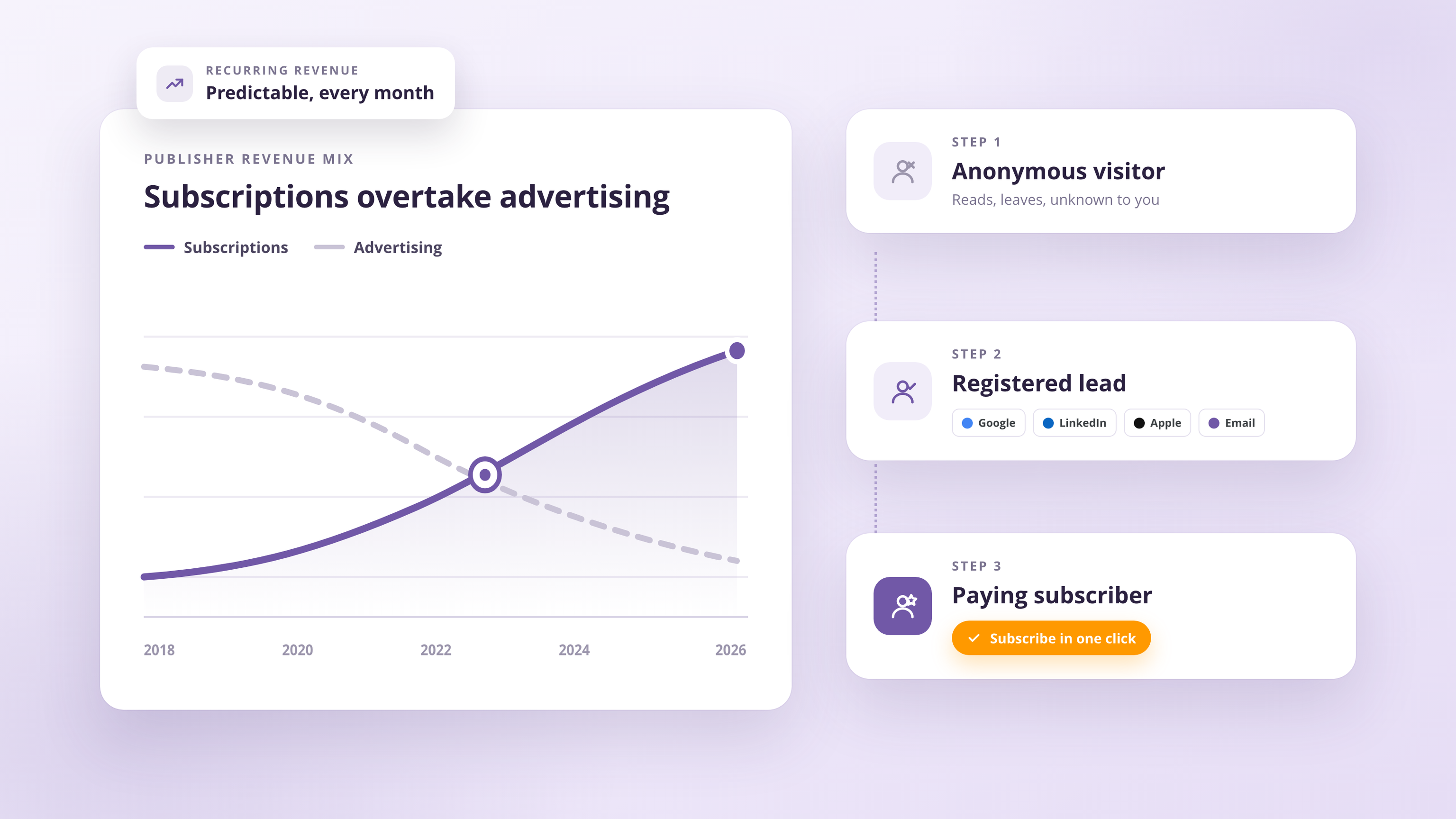
For decades, advertising was one of the most important revenue models for publishers and media companies. But our data shows a clear trend: subscriptions are increasingly taking over as the leading revenue model. So, why are subscriptions outperforming advertising?
From advertising to subscriptions
Since the early days of magazines and newspapers, media companies have traditionally relied on two main sources of revenue: advertising and subscriptions. Print has largely been replaced by websites and apps, but these two models remain the primary sources of revenue for most media businesses.
For a long time, third-party cookies were a major driver of digital advertising. They enabled advertisers to target audiences with increasingly precise ads based on their online behavior. As third-party cookies have been restricted or phased out across much of the digital ecosystem, publishers have faced growing pressure on their advertising revenues.
This has created a strong incentive for serious publishers and media businesses to build first-party data.
First-party data makes subscriptions easier
Building a consistent and valuable first-party data strategy usually requires publishers to know more about their audience. In practice, that means encouraging visitors to log in or create an account.
Fortunately, doing so has become increasingly easy. Users can often sign up with just a few clicks, for example through an email link or by using an existing Google, Facebook, LinkedIn, or Apple account.
Once visitors are logged in, publishers can better understand their interests and behavior. Let's call these users leads. From there, it becomes much easier to present them with relevant marketing messages and ultimately convert them into paying subscribers.
In some cases, publishers have reduced the process of purchasing a subscription to just a single click. Technically, starting a digital subscription has become significantly easier over the past few years.
Subscription revenue is more predictable
There is another major advantage to subscriptions: unlike advertising, subscriptions can largely be managed and processed through software.
Marketing, subscription management, payments, and billing can all be automated. This means publishers don't necessarily need a large sales organization to generate recurring subscription revenue.
And recurring revenue is perhaps the biggest advantage of all. Subscriptions generate revenue on a monthly, annual, or sometimes even weekly basis. This makes subscription revenue much more predictable than advertising revenue and generally less sensitive to economic cycles.
For publishers and media companies, that predictability is extremely valuable.
Why subscriptions are becoming the preferred revenue model
The shift from advertising toward subscriptions is not driven by a single factor. Several developments are coming together:
- Declining reliance on third-party cookies is making digital advertising less effective and less predictable.
- First-party data gives publishers a stronger understanding of their audiences.
- Low-friction registration and login make it easier to identify and engage individual users.
- Automated subscription technology has made it easier than ever to convert users into paying customers.
- Recurring revenue provides publishers with greater predictability and stability.
Advertising will remain an important revenue source for many media companies. But as the digital landscape changes, subscriptions are becoming an increasingly attractive business model for publishers looking for sustainable, predictable revenue.
The real question
The question is no longer whether publishers should consider subscriptions. For many media businesses, the more important question is how quickly they can turn anonymous visitors into registered leads, and leads into paying subscribers.
That's exactly the gap a leadwall is designed to close: let your best content do the work of turning readers into known, reachable leads, then convert them with a targeted, one-click offer.